Materials: Egger boards, ABS edging, HDF backs and painted fronts
What a fitted wardrobe is made of: melamine-faced chipboard, ABS edge banding in two thicknesses, HDF backs and drawer bottoms, and sprayed MDF fronts.
A fitted wardrobe is built from four kinds of material, each chosen for its own job. This page says what is what — so you know what you are buying and can compare quotes properly.
Carcass and shelves: melamine-faced chipboard
The base material is melamine-faced chipboard (Egger Eurodekor and equivalents). The core is chipboard; a decorative melamine facing is pressed onto both sides under heat and pressure.
- 18 mm thick for the carcass, shelves and fronts. Internal dimensions follow from it: internal width is the external width less twice the side thickness.
- Sheet size 2800 × 2070 mm. Not a detail: it determines how wide a wardrobe can be made in one piece (for us about 2770 mm) and when a wardrobe is split into two carcasses.
- The surface resists wear, scratches and moisture, and cleans with a soft cloth and mild soapy water.
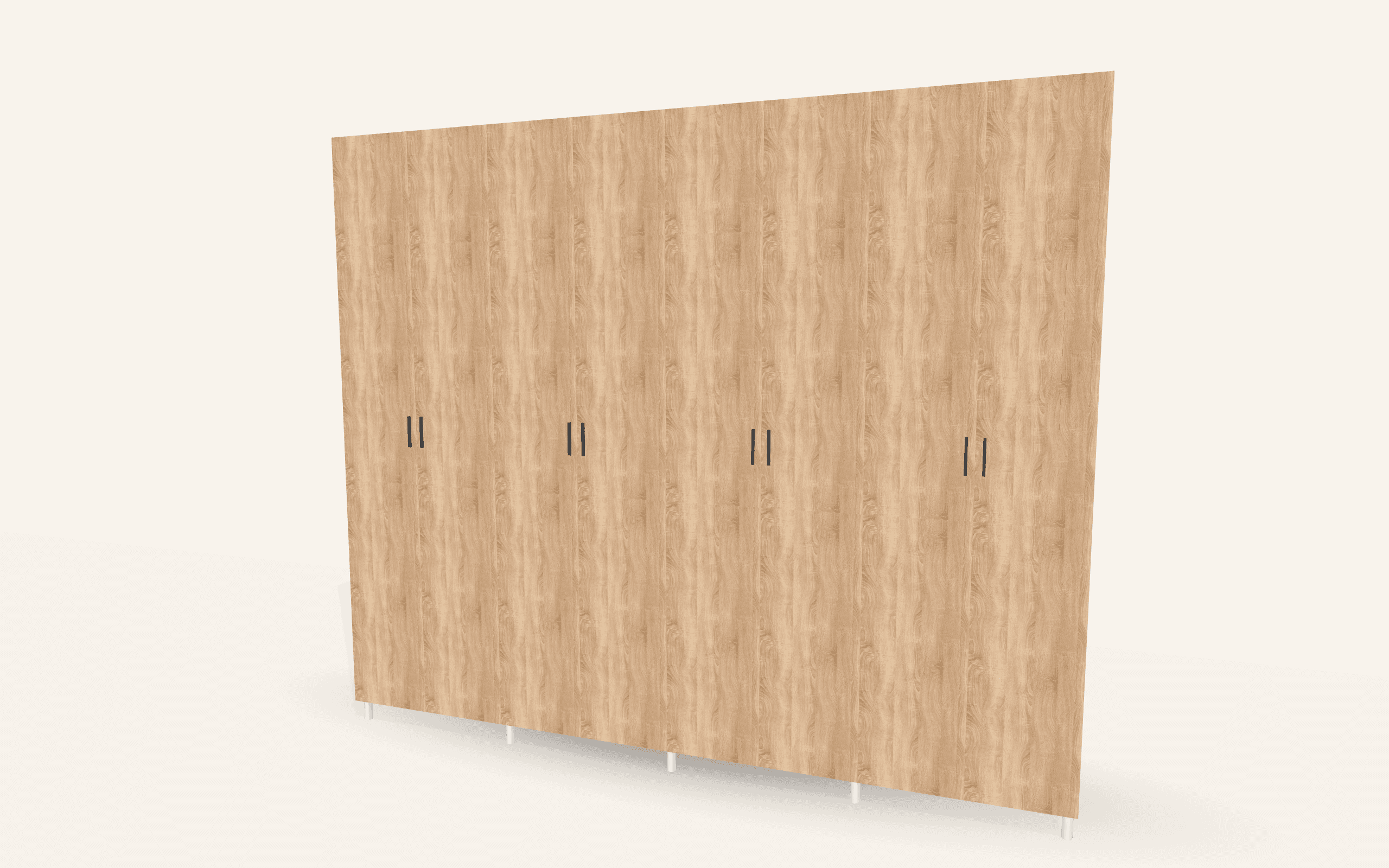
There are many decors: plain colours, woodgrains with pronounced texture, marbles. On woodgrains the grain direction matters — we cut so that it runs vertically on the fronts and lines up from leaf to leaf.
Edges: ABS banding, two thicknesses
A cut board edge is bare chipboard. To stop it absorbing moisture and to protect it, we band it with ABS edging matched to the decor's colour and texture.
We use two thicknesses, and the difference is deliberate:
- 2.0 mm on visible and exposed edges — fronts, shelf noses, the sides you see and touch. The thicker band takes knocks, has a slightly radiused edge, and does not lift under cleaning.
- 0.8 mm on internal, hidden edges — where the band does its technical job (sealing the chipboard) but is not on show.
The middle course — everything thin — is quicker and cheaper, and it shows on the fronts first.
Backs and drawer bottoms: HDF
The back panel is not an 18 mm board. It is HDF, 3 to 4 mm thick, white on the inner face, set into a groove in the carcass.
That is the right build for two reasons: a grooved back braces the wardrobe against racking (it acts as a diagonal tie) while adding neither weight nor cost the way a full board would. The same material is used for drawer bottoms.
Some builds make the back from the same 18 mm board as the carcass. That is not wrong — on a free-standing wardrobe whose back is visible it is better — but it is dearer and heavier. Both are available in the configurator.
Painted (sprayed) fronts
A painted front is not a board in a colour; it is a manufactured part:
- the substrate is MDF, which has a smooth homogeneous edge and can be routed;
- edge and face are sanded;
- a primer goes on, then sanding again;
- then lacquer in the chosen colour, sprayed in the booth, and drying.
That is why painted fronts sit at a different price from melamine ones: you are paying for labour and booth time, not for the paint. For the same reason a second colour on one wardrobe costs somewhat more than the first (one extra colour changeover in the booth) rather than twice as much.
We normally paint fronts and accents, not interiors. A melamine interior is more wear-resistant and much cheaper, and nobody sees the difference.
Glass and mirrors
Glass shelves, glazed leaves and mirrors are made to our measurements by a glazier. A mirror can be fitted to a leaf (outside or inside) or as a panel in a sliding door. For mirrors on doors we use a safety build with a backing film.
What to ask when comparing quotes
When you compare quotes from different makers, most of the difference hides here:
- What is the edge band thickness on the fronts? (2.0 mm versus 0.8 mm is a difference you see and feel.)
- Is the back panel grooved in, or just pinned to the rear?
- Are the drawer bottoms HDF or cardboard?
- Is the hardware named by maker and model, or only described as "soft-close"?
The last point is covered in Why Blum.
Next step
Try the decors in the configurator — swapping one is free and the price difference appears immediately. Built combinations are among our designs.
Frequently asked
- What is the difference between 2.0 mm and 0.8 mm edge banding?
- The thicker band goes on visible and exposed edges (fronts, shelf noses), because it takes knocks and does not lift under cleaning. The thinner one goes on internal, hidden edges where the band only has to seal the chipboard.
- Why is the back panel a thinner board?
- Because 3 to 4 mm HDF set into a groove is the correct build: it braces the wardrobe against racking while adding neither weight nor cost. If you want the back in the same 18 mm board as the carcass, that is possible too.
- Why do painted fronts cost more than melamine?
- Because a painted front is not a board in another colour; it is MDF that is sanded, primed, sprayed and dried. You pay for labour and booth time — the pigment itself is the smallest part of the difference.
- What does a second colour on the same wardrobe cost?
- Somewhat more than the first, not twice as much: it is one extra colour changeover in the spray booth, not a second job.
- Does the grain line up between leaves on woodgrain decors?
- Yes. On woodgrains we respect the grain direction and cut so that it runs vertically on the fronts and lines up from one leaf to the next.